Culturally Responsive Teaching and the Brain by Zaretta Hammond & Yvette Jackson
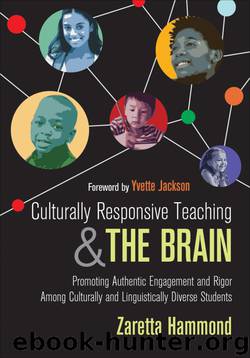
Author:Zaretta Hammond & Yvette Jackson
Language: eng
Format: epub
ISBN: 9781483308029
Publisher: SAGE Publications
Published: 2015-02-20T16:00:00+00:00
WHY MARGINALIZED DEPENDENT LEARNERS NEED AN ALLY
I met tenth-grader Tyree when I was working with a secondary English Language Arts teacher who had been assigned to what her school district called a “strategic reading class.” The strategic reading class was made up of ninth and tenth grade students, largely African Americans with some Latinos students, the majority boys who were reading several years behind grade level. Most of them read at the third to fourth grade level. Tyree’s teacher, Marci and I were beta testing a literacy curriculum I was developing to accelerate high school students’ reading development. Tyree read at the third grade level, but was naturally smart and a bit of a ham. But reading is the primary vehicle for taking in new knowledge in school after fourth grade, and because of his low skills, Tyree had fallen way behind.
His academic challenges weren’t just that he couldn’t read but that his background knowledge was shallow and his academic vocabulary was small. He couldn’t do complex analytical work. Tyree was always up for trying out the learning tools and games I brought for the class to test. I could tell his slow reading frustrated him. He didn’t even try when asked to read a complex grade level text. Instead, he feigned disinterest and said this was boring and a waste of time. Tyree was a dependent learner in need of an ally like his teacher, Marci. She didn’t blame the students for their reading problems but she didn’t sugar coat things either. She pushed them to roll up their sleeves and work to become better readers. In turn, she rolled up her own sleeves right alongside them to find the right tools and most effective strategies. She was their ally.
The alliance phase of the learning partnership speaks to the realities of education in the sociopolitical context that creates unequal academic outcomes for students of color, English learners, and poor students. The education system has historically underserved culturally and linguistically diverse students of color. We have acknowledged the achievement gap that has left many of them with lower skills, unable to do higher order, academically challenging work. Because of institutional inequities, these students have underdeveloped “learn-how-to-learn” skills as well as weak foundational skills in reading and analytical writing (Boykin, Tyler, & Miller, 2005).
As a result, many students go from grade to grade, like Tyree, without becoming proficient readers, writers, or mathematicians. Their awareness of their own lack of academic proficiency leads to a lack of confidence as learners. Unfortunately, many culturally and linguistically diverse students start to believe these skill gaps are evidence of their own innate intellectual deficits. They internalize the negative verbal and nonverbal messages adults at school send to them in the form of low expectations, unchallenging remedial content, and an overemphasis on compliant behavior (Solorzano & Yosso, 2001).
On the inside, many students of color become discouraged and disengaged. In high school, we see them in the back of the classroom, hoodies pulled over their heads, head on the desk napping during the lesson, or painting fingernails.
Download
This site does not store any files on its server. We only index and link to content provided by other sites. Please contact the content providers to delete copyright contents if any and email us, we'll remove relevant links or contents immediately.
The Art of Coaching Workbook by Elena Aguilar(51136)
Trainspotting by Irvine Welsh(21608)
Twilight of the Idols With the Antichrist and Ecce Homo by Friedrich Nietzsche(18601)
Fangirl by Rainbow Rowell(9211)
Periodization Training for Sports by Tudor Bompa(8237)
Change Your Questions, Change Your Life by Marilee Adams(7717)
This Is How You Lose Her by Junot Diaz(6857)
Asking the Right Questions: A Guide to Critical Thinking by M. Neil Browne & Stuart M. Keeley(5741)
Grit by Angela Duckworth(5576)
Red Sparrow by Jason Matthews(5449)
Paper Towns by Green John(5163)
Room 212 by Kate Stewart(5091)
Ken Follett - World without end by Ken Follett(4705)
Housekeeping by Marilynne Robinson(4420)
The Sports Rules Book by Human Kinetics(4367)
Double Down (Diary of a Wimpy Kid Book 11) by Jeff Kinney(4252)
Papillon (English) by Henri Charrière(4238)
The Motorcycle Diaries by Ernesto Che Guevara(4069)
Exercise Technique Manual for Resistance Training by National Strength & Conditioning Association(4048)
